
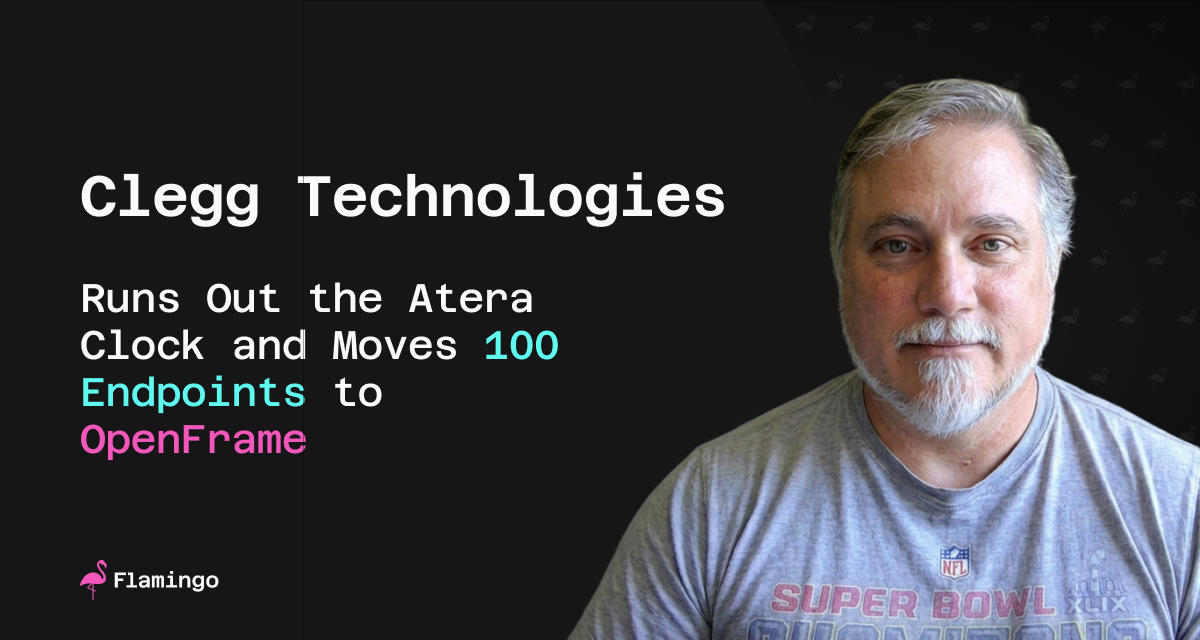
Clegg Technologies Ditches Atera Mid-Contract for OpenFrame


1-50
Employees
500
Managed Seats
Summary
When a 30-year MSP veteran decides to migrate away from a platform he already paid for, that says everything about the solution replacing it. Brandon Clegg, founder of Clegg Technologies, is doing exactly that - actively migrating clients to OpenFrame and Flamingo during the beta period, even while his Atera contract runs its course. With roughly 500 endpoints under management across clients in California, Arizona, and internationally, Clegg is not making this move lightly. He is making it because the platform his technicians use every day has already changed how his team works.
The story at Clegg Technologies is one that will resonate with any MSP owner who has watched skilled technicians get dragged back into L1 tickets the moment a strategic project gets underway. Brandon's team was duct-taping together Atera, Bitdefender, and Avic - three separate platforms with no unified integration layer - while simultaneously trying to grow the business and move upmarket into MSSP services.
OpenFrame's AI-powered platform, anchored by the technician-side copilot Mingo and the end-user agent Faye, offered a path out of that cycle. Techs are already using Mingo daily to diagnose issues, build monitoring scripts, and execute approved fixes. The full migration is planned for contract renewal, with the potential to scale to 2,000-plus endpoints without proportional headcount growth.
Challenge
Brandon Clegg built Clegg Technologies over three decades by staying close to his clients and delivering reliable, hands-on IT support. But as the business grew to manage roughly 500 endpoints across industries ranging from manufacturing and legal to retail and construction, the operational cracks became harder to ignore.
The most immediate pain point was tool fragmentation. Clegg's team was running Atera for RMM and PSA functions, Bitdefender for endpoint detection and antivirus, and Avic for network monitoring - three separate platforms with no unified integration layer. Every day, technicians were context-switching between dashboards, manually correlating data, and losing time to the friction of a disconnected stack. The per-tech, per-month pricing model that initially made Atera attractive was also becoming a ceiling: scaling the business would mean scaling headcount at the same rate, eroding margins as endpoint counts grew.
Beyond the tooling, there was a deeper operational problem. When Brandon assigned technicians to higher-level projects, those same techs kept getting pulled back into L1 tickets. As he put it, 'I gave you this project, where are we at? Well, I started it but then I got pulled to this company.' Strategic work stalled. Growth stalled with it. The team needed a way to absorb routine support volume without consuming the bandwidth of skilled technicians - and the existing stack offered no real answer to that problem.
Solution
Brandon's path to OpenFrame started with a social media ad he almost ignored. After signing up for the beta and starting slowly with a handful of small clients, the platform quickly proved its value where it mattered most - inside the daily workflows of his technicians.
Mingo, OpenFrame's AI-powered technician copilot, became the first real proof point. Clegg's techs began using Mingo to diagnose device issues, execute approved remediation steps, and build out the monitoring scripts and policies that form the backbone of proactive MSP service delivery. One technician in particular took it further, learning the entire platform through Mingo as a primary interface. Rather than treating AI as a bolt-on feature to be evaluated later, the team integrated it into how they actually work - which is precisely how OpenFrame was designed to be adopted.
On the client side, Faye - the end-user-facing AI agent - represents the next phase of the rollout. Clegg's clients are currently conditioned to submit tickets via email and a traditional help desk portal, so retraining them to interact with Faye requires a deliberate onboarding effort. A formal client presentation is in progress. One manufacturing client with 200-plus endpoints is already eager to move forward, drawn specifically by Faye's ability to give their workforce an AI-interactive layer for self-service support. The migration strategy is methodical: start with smaller clients, validate monitoring configurations, then expand - with a full platform switch planned at Atera contract renewal.
Results
The results at Clegg Technologies are still unfolding, but the directional signal is clear enough that Brandon committed to a full platform migration before the beta even concluded - and before his existing contract expired. That is not a decision a 30-year industry veteran makes without confidence in what he is moving toward.
On the technician side, Mingo is already delivering measurable workflow improvements. Techs are diagnosing faster, executing fixes through an AI-guided interface, and building monitoring infrastructure that would previously have required significantly more manual effort. The context-switching tax of managing three disconnected platforms is being replaced by a unified layer that keeps technicians in one place.
The larger opportunity, however, is in the numbers. Brandon estimates that full Faye and Mingo adoption across his client base would be 'invaluable' and 'a massive shift' for the business. With roughly 500 endpoints today and a realistic path to 2,000-plus, the ability to absorb that growth without proportional headcount increases changes the unit economics of the entire operation. He is equally confident about client-side adoption: 'If my clients are aware of it, they'll use it - I almost guarantee that 90% of my clientele would actually start utilizing it pretty frequently because none of them like to call, none of them like to text, none of them like to send in help desk tickets.' For Clegg Technologies, the migration is not a gamble. It is a calculated bet on where the business needs to go.
Key Quotes · 1
“90% of my clientele would start utilizing it”
