
Clegg Technologies Moves to OpenFrame, Client by Client


1-50
Employees
500
Managed Seats
Summary
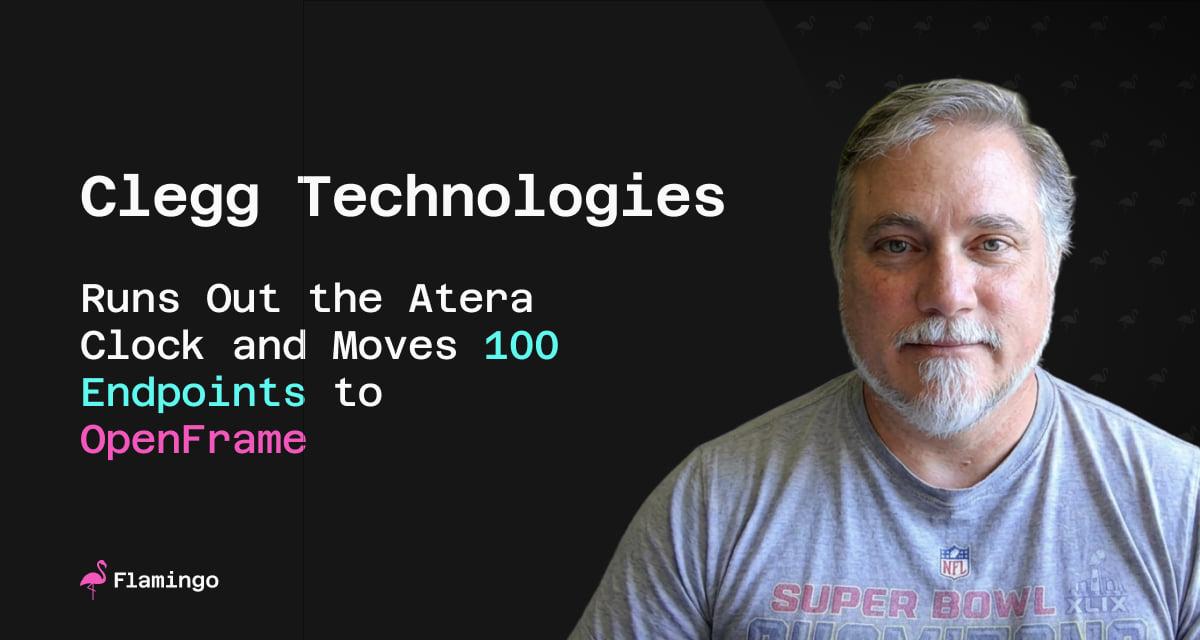
Brandon Clegg has spent 30 years in IT and runs Clegg Technologies, an MSP that's moving into security work as an MSSP. His team looks after about 500 endpoints for law firms, construction companies, manufacturers and retailers. Most clients are in California, with others in Arizona, Germany, Singapore and China.
He found Flamingo through social media ads, read up on it, and parked it. A few months later, with other RMM vendors pitching him, he remembered it, joined the beta and started small. At the interview in July 2026, about 100 of his roughly 500 endpoints were on OpenFrame. Atera was still running alongside it while his team moved clients over one at a time.
The early wins sit with his technicians. When they're stuck, they ask Mingo, OpenFrame's technician copilot, and get the fix, or let Mingo run it once a tech approves. One tech is building client monitoring with Mingo. Brandon also put Fae, the agent that sits on client machines, through a test of his own. Asked what's stopping a full switch, he didn't list blockers: "Honestly, it's just a matter of time."
~100
endpoints on OpenFrame, out of about 500
100%
of endpoints deployed at his first pilot clients
No blockers
to a full switch: "just a matter of time"
Challenge
Clegg Technologies has no niche. Brandon's clients range from law offices to manufacturers, and many have been with him for 20-plus years. That variety means every client is a little different, a point he comes back to when he talks about AI.
The stack is a familiar one: Atera for RMM and help desk, Bitdefender for EDR and antivirus, and Auvik for network monitoring. Each tool does its job. Getting them to work together is the hard part. In Brandon's words, the interfacing between them is "just a pain in the butt."
Atera came in years ago for a simple reason. It billed per technician, not per endpoint, which suited a one-tech shop with 250 endpoints. Now that a few more people work for him, that edge is gone: what he pays is close to what other vendors charge.
The bigger issue is where his techs spend their day. They tend to stay in break-fix mode. Brandon hands them a project, asks where it stands, and hears a familiar answer: "I started it, but then I got pulled to this company over here." He wants them on higher-level work.
His clients add one more wrinkle. None of them like to call, text or log a ticket. Problems often surface only when a tech is on site for something else, after an issue has been bugging someone for a month.
Solution
Brandon joined the OpenFrame beta and started slow. The first clients were small offices with five to ten devices each, and the team deployed to every endpoint there. Bigger clients got a test group of five or ten devices first, then more. By the interview, about 100 endpoints were on OpenFrame.
Monitoring sets the pace: "So we're, we're, we're slowly migrating our clients as we get the monitoring in place and situated." One of his techs is building that monitoring with Mingo's help and learning the platform inside out along the way.
Day to day, Mingo is where his techs go when they're stuck. Brandon encouraged it, and they took to it. They talk the problem through with Mingo, get the answer and the fix, and can have Mingo run the fix once a tech approves. These are his techs' stories. Brandon spends his own time on bigger projects.
Fae is the client-side piece, and Brandon tested it himself first. He told it an application wasn't working and couldn't be reached. Fae offered checks and tests, and he let it run them all, without being on the server's network. When it couldn't fix the problem, it said a tech was needed and flagged his team. Clients still email tickets to the help desk, so his team is introducing Fae in batches: what the tray icon looks like, and what to type when something breaks.
He also has a view on why this works. Every client is different. Fae sits on the machine, so it sees the device and the network it's on. An AI attached to an existing stack can only read what's already in place.
Results
At the interview in July 2026, the results were about adoption, not hours saved. Clegg Technologies had about 100 of its roughly 500 endpoints on OpenFrame, with every endpoint deployed at its first pilot clients. Atera was still running alongside it.
His techs had made Mingo part of the job: "So they like it. They love it actually. So it's very easy for them to handle everything." When a fix is needed, "They can even have Mingo just do it as long as they approve it."
Brandon's own Fae test ended the way he wants it to end for clients. Fae ran the checks without him on the server's network, and when it hit its limit, it handed off: "we also can see when Fae is unable to fix the situation, it does flag us to make sure that we check it out." That visibility is what he plans to show clients. Fae wasn't yet heading off client tickets, because clients were still learning it was there.
His take on the approach: "it just makes more sense the way that OpenFrame works and Flamingo works." Asked what was blocking a full switch, he named nothing: "Honestly, it's just a matter of time." His Atera year was already paid for, so the plan was to keep migrating slowly and, in his words, "pull the trigger probably" at the end of it.
What he still wants, framed as polish: a way for clients to reach Fae or Mingo by email when their computer is down, a smoother monitoring setup, more integrations, and EDR and backup in the same platform. What he expects next: once clients know Fae is there, he thinks about 90% of them would use it, because none of them like to call, text or send in tickets.
Key Quotes · 8
“They've seen situations where they're just like, I don't know what to do. And they'll, they'll talk to Mingo and it's like, oh, here's the answer, here's how they fix it.”
Brandon Clegg
“They can even have Mingo just do it as long as they approve it.”
Brandon Clegg
“So they like it. They love it actually. So it's very easy for them to handle everything.”
Brandon Clegg
“One of my techs, he's, he's using Mingo to kind of help him set up all the monitoring and everything like that.”
Brandon Clegg
“And I had it do it all. Mind you, I was not on the network where that server existed.”
Brandon Clegg
“We also can see when Fae is unable to fix the situation, it does flag us to make sure that we check it out.”
Brandon Clegg
“It just makes more sense the way that OpenFrame works and Flamingo works.”
Brandon Clegg
“Honestly, it's just a matter of time.”
Brandon Clegg
Related Content
Frequently Asked Questions
/case-studies/clegg-technologies-moves-to-openframe-client-by-client
Still deciding?
Ask Mingo answers from our docs and customer stories.