
LNC Data Tests OpenFrame's Vulnerability View on Real Client Servers


1-50
Employees
600
Managed Seats
Summary
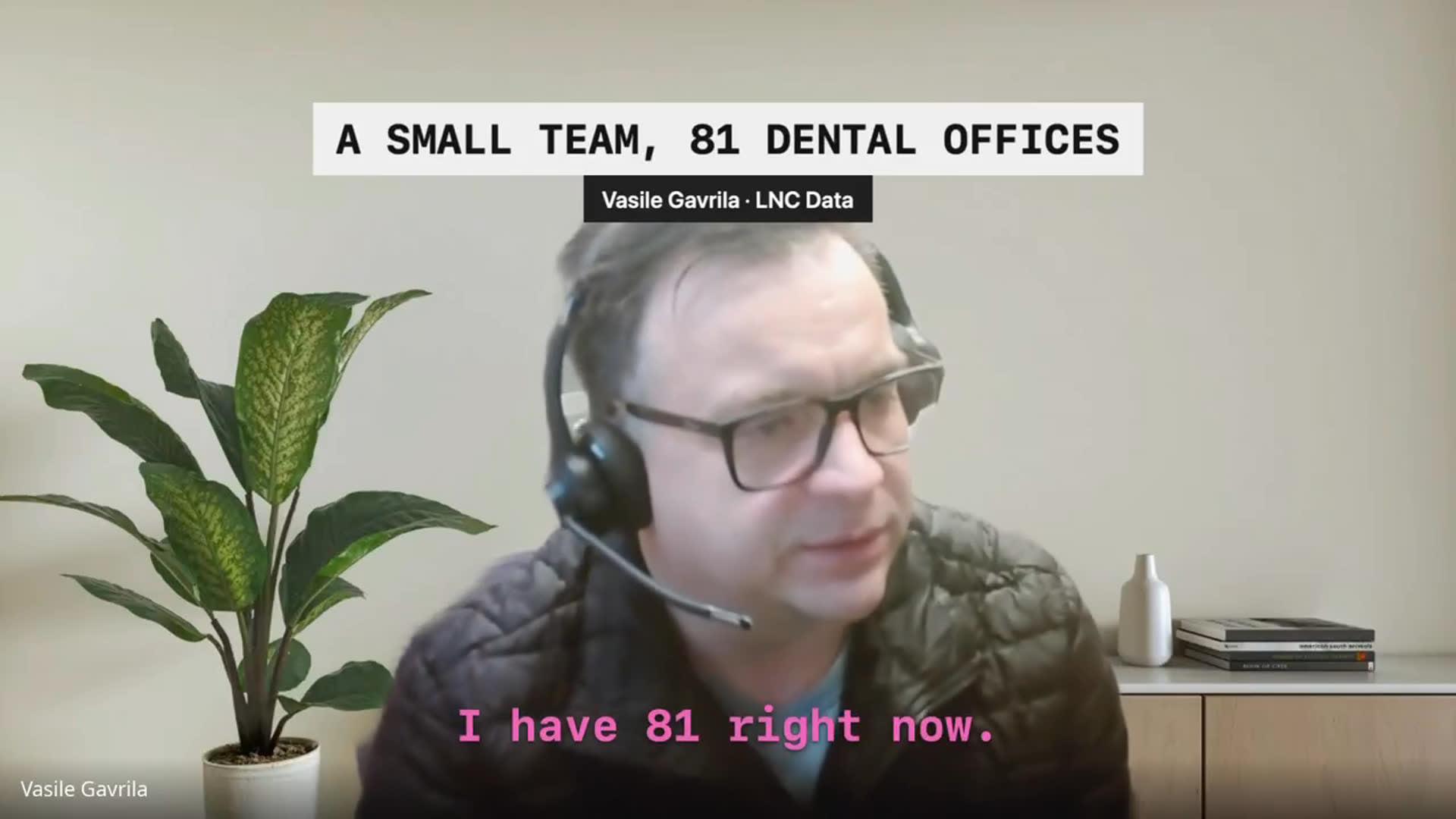
Vasile Gavrila runs LNC Data, a three-person MSP that looks after 81 dental offices. Most offices have about seven computers and an on-site file server with the shared folders their practice software uses. One office is in Romania, and he manages it remotely.
His current RMM runs about 700 agents across those clients, and he's used it for more than three years. Per-technician pricing that multiplies with every add-on sent him looking for an alternative. Flamingo came up on Reddit, and he joined the community Slack and the OpenFrame beta from there.
At the interview in January 2026, OpenFrame was on four devices, all real client servers rather than test machines. He hadn't switched. What he logs in for is the compliance view: patches and software vulnerabilities in one place, each vulnerability linked to an article on how to fix it. It was the first time he'd seen that in an RMM.
4
real client servers on OpenFrame, not test devices
First
time he'd seen software vulnerabilities in an RMM
Pretty well
how remote restarts and software installs ran
Challenge
LNC Data is a small team with a lot of offices. Three people look after 81 dental organizations, from three computers up to fifteen. Most of the work is network connectivity, updates and calls about a slow system, plus keeping each office's file server backed up.
His current RMM bills per technician, and that part suits him. He sometimes onboards temporary clients for three or four months, and a fixed price per tech means he doesn't have to worry about his bill going up and down as their devices come and go. The catch is the multiplier. Every technician he adds raises the bill, and with three techs, every add-on feature costs him three times over. In his words, it was getting "too expensive for me to keep using it."
Patching runs automatically on his current RMM, but failed patches still land on him. When an update doesn't go through or a computer was off, someone has to read the report, check the machine and schedule it again.
Solution
Vasile found Flamingo on Reddit while researching a replacement. He joined the community Slack, asked for access to the OpenFrame beta and sat in on a group webinar.
Then he put the agent on four devices. They aren't test machines: "They're real clients. And they're all servers." The trial is small, but it runs on machines his clients rely on.
The feature he uses most is the compliance view: "One feature that I do like in here is when you go to the compliance option where you can see all the patches. That's really nice." Next to the patches, OpenFrame lists vulnerabilities in the software installed on each device and links each one to an article that explains it and how to deal with it. Checking those vulnerabilities is the main thing he logs in to do. For everything else, his current RMM still covers him.
His current RMM has a patch score too, but it only covers Microsoft security updates. OpenFrame looks at the software. As he put it: "But OpenFrame has it specifically for software. I think it's better."
He's also run remote commands on those servers, like restarts and software installs, and they went through without trouble.
Results
At the interview in January 2026, the results were about fit, not hours saved. OpenFrame ran on four real client servers in dental offices, next to his current RMM, which still covered his roughly 700 agents. He hadn't switched, and he hadn't tried mobile device management yet.
The vulnerability view had become the reason he logged in: "I'm just checking those vulnerabilities. I think that's a really cool feature to have there." It was the first time he'd seen software vulnerabilities in an RMM, and he rates it above patch scoring that stops at Microsoft updates.
Remote commands held up too: "It's pretty responsive. If I send it a command like restart the system or install a software, it executes this pretty well."
What would it take to switch? "I guess the features available and the cost."
What he still wants: remote-control integrations with third-party tools that create a one-time secure access code, chat between technicians inside the dashboard, after-hours unattended access that doesn't wait for someone at the office to approve it, ticketing, and a dashboard that stays fast as device counts grow. He'd also like AI to re-check failed patches and reschedule them when a computer comes back online.
What he expects next: with an AI tool in the loop, he thinks his offices could see less downtime and faster fixes.
Key Quotes · 7
“One feature that I do like in here is when you go to the compliance option where you can see all the patches. That's really nice.”
Vasile Gavrila
“And then you can see all the vulnerabilities on a software. It also redirects you to an article that describes that vulnerability, and you can take care of it.”
Vasile Gavrila
“I'm just checking those vulnerabilities. I think that's a really cool feature to have there.”
Vasile Gavrila
“This vulnerability feature, it's a really nice tool in there.”
Vasile Gavrila
“But OpenFrame has it specifically for software. I think it's better.”
Vasile Gavrila
“They're real clients. And they're all servers.”
Vasile Gavrila
“It's pretty responsive. If I send it a command like restart the system or install a software, it executes this pretty well.”
Vasile Gavrila
Key Moments

Related Content
Frequently Asked Questions
/case-studies/lnc-data-tests-openframe-vulnerability-view-on-real-client-servers
Still deciding?
Ask Mingo answers from our docs and customer stories.